
A famous saying from Bari states: “If Paris had the sea, it would be a small Bari”.
Anyone who hears this famous motto for the first time usually reacts in one of two ways. If he’s French – or actually from Paris – he turns up his nose a little and exclaims This is not possible!.
But what if instead non he is French, let alone from Paris, he usually looks around and recognizes that it is actually true. Especially if he is in one of the at that moment more neighborhoods chic and sophisticated people of our city.
Murat, Umbertino and Madonnella they are the neighborhoods of the new city where the spirit is concentrated bohemian of Bari, made of imposing style buildings liberty, artisan workshops, independent and elegant bookshops boutique.
In these streets it is possible to meet an exquisite cocktail Of retro look and contemporary taste, framed in a splendid mix of architecture, design urbanization and society that transforms our Bari into a small and exquisite miniature Paris.
Our new free tour The Bohémien was born precisely to give travelers like you a breathtaking experience of the most refined soul of Bari, walking through the large shopping streets and the colorful streets of the city center.
Do you want to discover all the stages of this itinerary? Then continue reading!
Via Sparano: the shopping street of the Murat district
The new free tour The Bohémien begins in one of the most famous streets in the center of Bari: Via Sparano, an unmissable stop for those who love fashion and shopping.
Among the glittering shop windows of boutiqueHowever, it is possible to see some of the buildings that have made the history of this very important street in the Murat district.
The Church of San Ferdinando
This is the case of Church of San Ferdinando, the starting point of our free tour, which with its curious mustard color stands out among the signs of large cosmetics and clothing stores.
Located in the exact center of via Sparano, this church with massive and unusual architecture tells a story worthy of the best picaresque novels.
The Church of San Ferdinando was in fact built way back in 1843 on commission from Ferdinand II, then sovereign of the Kingdom of the Two Sicilies.
The original project included a simple church in neoclassical style, but when the structure was completed the community of Bari did not hesitate to rename the new religious building “a beautiful stable”.
The first Church of San Ferdinando had 2 large columns with Ionic capitals at the entrance, surmounted by a large clock, and lateral facades with 2 rows of moon-shaped windows. In short, not exactly a masterpiece design.
In the 1934, then, this poor little church was subjected to extensive works restoration. Among other things, the clock was removed from the main facade and large staircases were added.
Thus the Church of San Ferdinando took on thesevere and vaguely littorial appearance which we can still admire today.
Mincuzzi Palace
Proceeding along Via Sparano, we arrive at second stop of our free tour The Bohémien.
This is a glitzy one style palace Art Nouveau surmounted by a large green dome, which towers along the famous shopping street: Mincuzzi Palace.
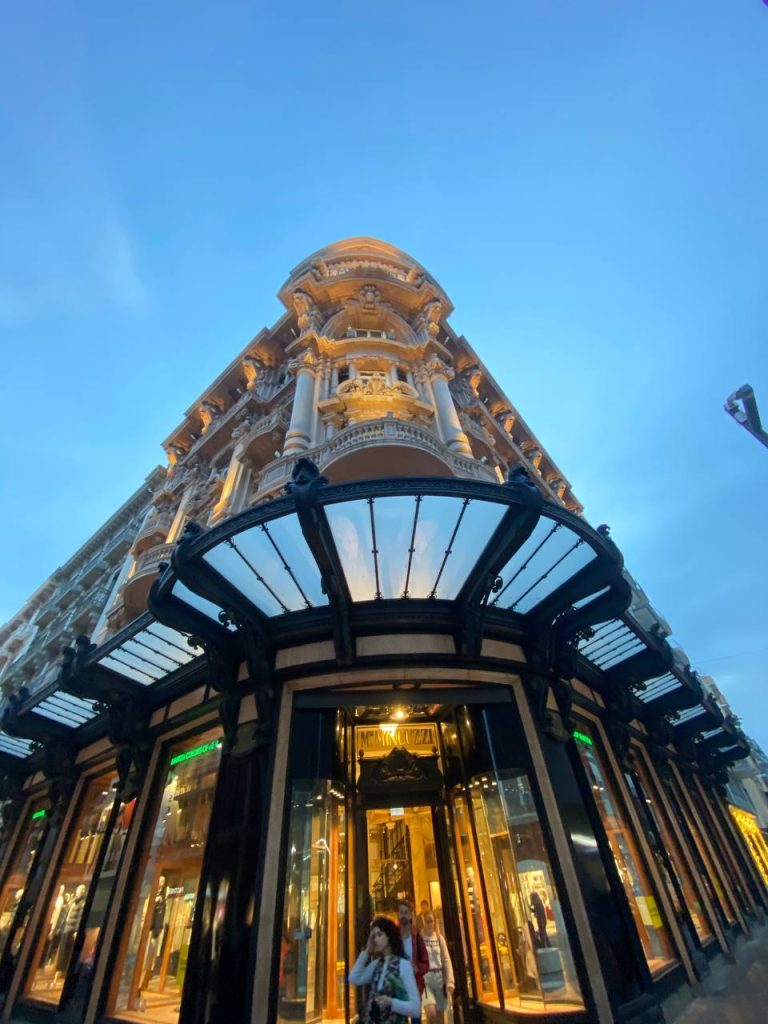
With its red brick façade and decorated with capitals, Palazzo Mincuzzi is today the headquarters of boutique of a famous one brand fashionable.
But its story begins in 1928, when the works of the architect Aldo Forcignanò were completed and the building was inaugurated as the seat of theworkshop of the famous Mincuzzi family from Bari.
The structure of Palazzo Mincuzzi is inspired by design architectural of some of the major European capitals including, not surprisingly, its own figure Paris.
This astonishing structure soon became one of the most iconic symbols of via Sparano and the rich social life of the Bari bourgeoisie.
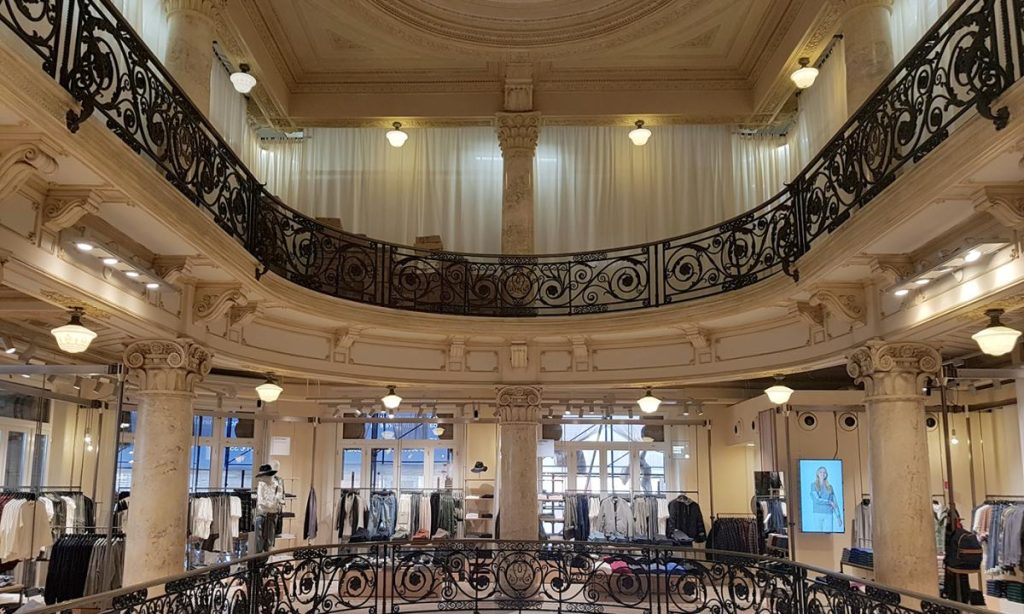
Suffice it to imagine that the top floor of Palazzo Mincuzzi was often used as ballroom during the great parties of the city’s high society.
The Umbertino district: between theaters and liberty palaces
Our free tour The Bohémien continues towards the Umbertino neighborhood, which occupies first place on the podium most elegant areas of Bari thanks to the riot of theaters and sophisticated palaces liberty along its streets.
Before entering the streets of this area very chic However, let’s stop on the extreme edge that separates the Umbertino neighborhood from the Murat neighborhood to discover the history of two buildings engaged in a no-holds-barred struggle for almost a century… of architecture!
The Petruzzelli Theatre
It’s the fourth largest theater in Italy and on its stage the famous Rudolf Nureyev danced: the Petruzzelli Theatre It stands out with its red brick façade on the street that separates the Murat district from the Umbertino.
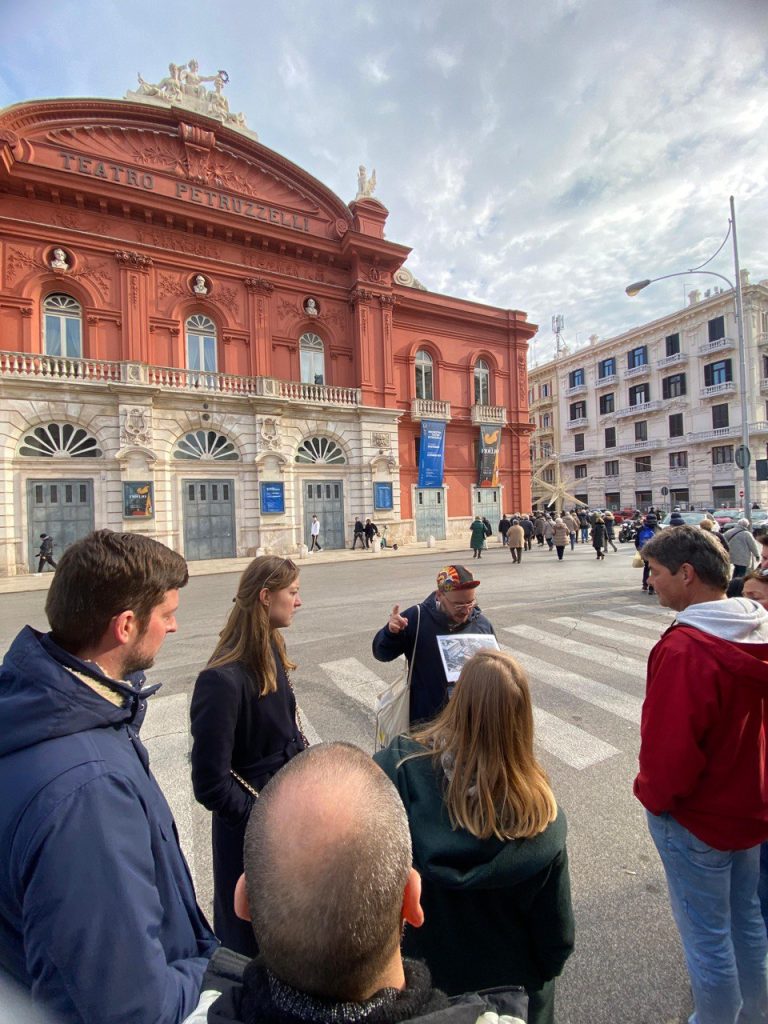
Inaugurated in 1903, the Petruzzelli Theater is undoubtedly one of the most famous theaters in our city also due to its troubled history.
In 1991, while the famous opera was being staged Norma by Bellini, a vast fire razed the ancient wooden structure of this theater to the ground.
The causes of this disaster are still unknown today, but the Petruzzelli fire writes a very sad page in the history of our city.
After almost 20 years of restoration work, in 2009 the Petruzzelli Theater was returned to the people of Bari according to the architectural principle of “where was it, how was it”.
The structure that we can visit today, in fact, is identical in every way to the original one… except for one detail.
Before the fire of 1991, the hall of the Petruzzelli Theater was surmounted by a gigantic frescoed dome. Unfortunately these frescoes were destroyed by flames, making their reconstruction impossible.
This is why Petruzzelli’s dome now stands out like a large white canvas, almost like a scar from the terrible accident.
Palazzo Scattarelli
Right in front of the magnificent Petruzzelli Theater stands a grandiose building with an austere appearance.
It’s about Palazzo Scattarelli, a building that with its grandeur seems to want to mock the elegant theater of Bari.
This palace was built in 1915 at the request of Nicola Scattarelli, a fabric seller who had been an employee of Antonio and Onofrio Petruzzelli, the owners of the famous Politeama theater.
Legend has it that there was really bad blood between the Petruzzelli brothers and Mr. Scattarelli, especially following the resignation of the latter.
Thus, when Nicola Scattarelli managed to make ends meet thanks to his business as a trader, out of spite he had a building built in his name right in front of his former employers’ gem!
The liberty buildings of the Umbertino district
Passing the Petruzzelli Theater, we finally look out into the del Umbertino neighborhood.
Right here some of the gods arise some of the most beautiful and characteristic liberty palaces of Bari, only a few meters away from each other.
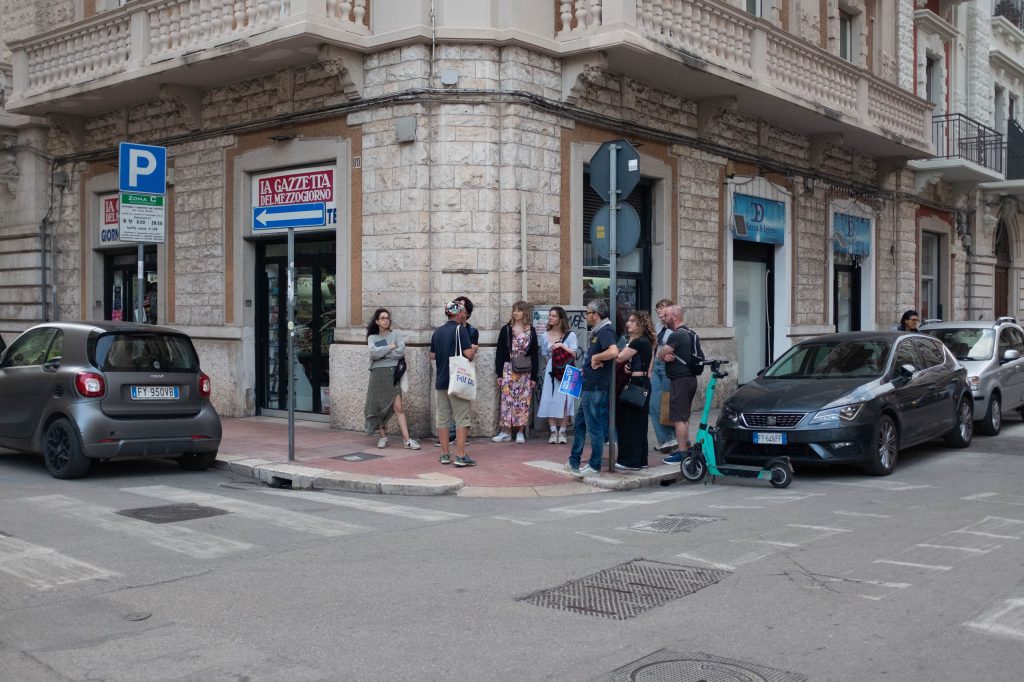
The first one we encounter on our route is perhaps the most photographed building in Bari: the Palace of State Employees.
Its facade art-deco colored white and red, it immediately catches the eye, also thanks to the almost perfect geometry of its structure.
Built in 1926, this splendid building housed the apartments of public employees who they covered prestigious positions in the city of Bari, such as university professors and magistrates.
Moving a few meters away we encounter another colorful building built in style liberty European: Palazzo Gomes.
Its amaranth façade is embellished with stylized marble flowers and emerald-coloured wooden shutters, while on the sides of the building there are two coats of arms bearing the date “1910”, the year the building was built.
Not far from Palazzo Gomes stands another building with fascinating architecture: the Palace of the Apulian Aqueduct.
The building was designed and built between 1930 and 1937 by the young engineer Cesare Brunetti, who was inspired by the Apulian Romanesque style.
The white facade of the building is in fact made of Trani stone and decorated with style inlays neo-liberty which recall the beauty and preciousness of water.
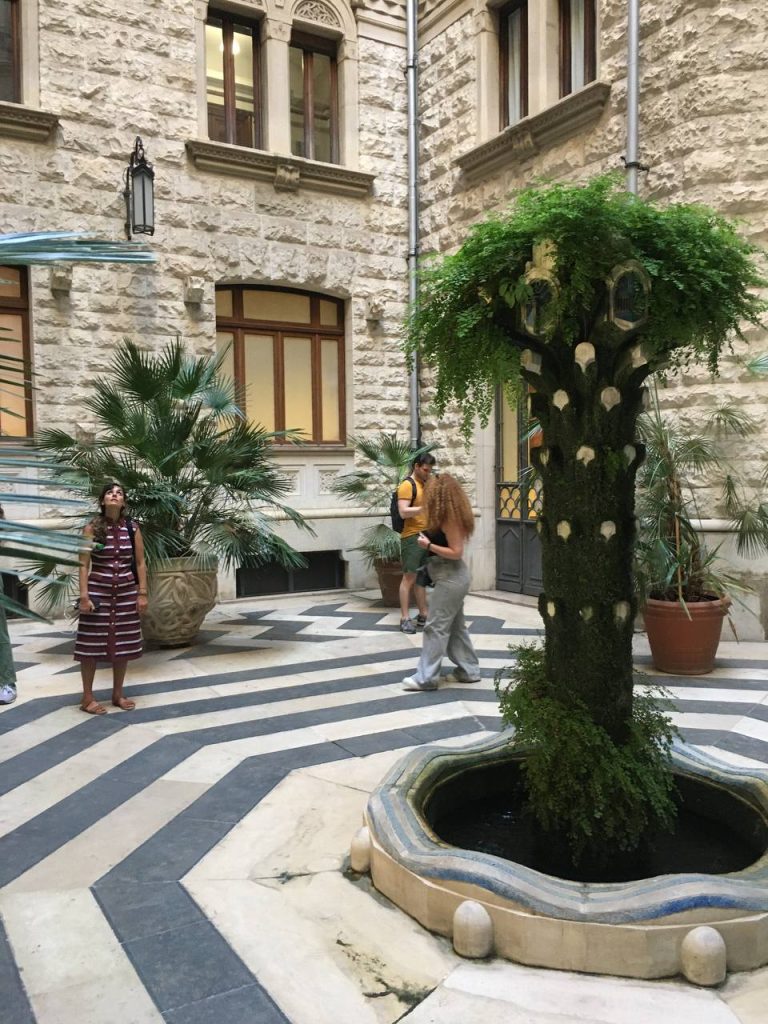
Not far away we come across a tall pink building surmounted by two small towers on the ceiling.
It is the former Miramare Hotel, built in 1927 mixing architectural suggestions of classical, baroque and romantic taste.
But what makes this building truly evocative is the large panoramic terrace on the top floor, from which it is possible to admire the Bari seafront in its entirety.
Our tour of the Umbertino neighborhood ends in Via Imbriani, whose block is entirely dominated by the ancient façade Palazzo De Giglio.
Built in 1912, this splendid palace was the private residence of the Knight Francesco De Giglio and is characterized by a magnificent façade that combines elements of the late liberty and neoclassical.
The Madonnella neighborhood
The last stops of our free tour The Bohémien they accompany us inside Madonnella, one of the oldest and most multifaceted neighborhoods of our city.
Among low colored houses, small independent bookshops, charming shops vintage and large squares surrounded by period buildings liberty, Madonnella strikes for the richness of contrasts who coexist along its streets.
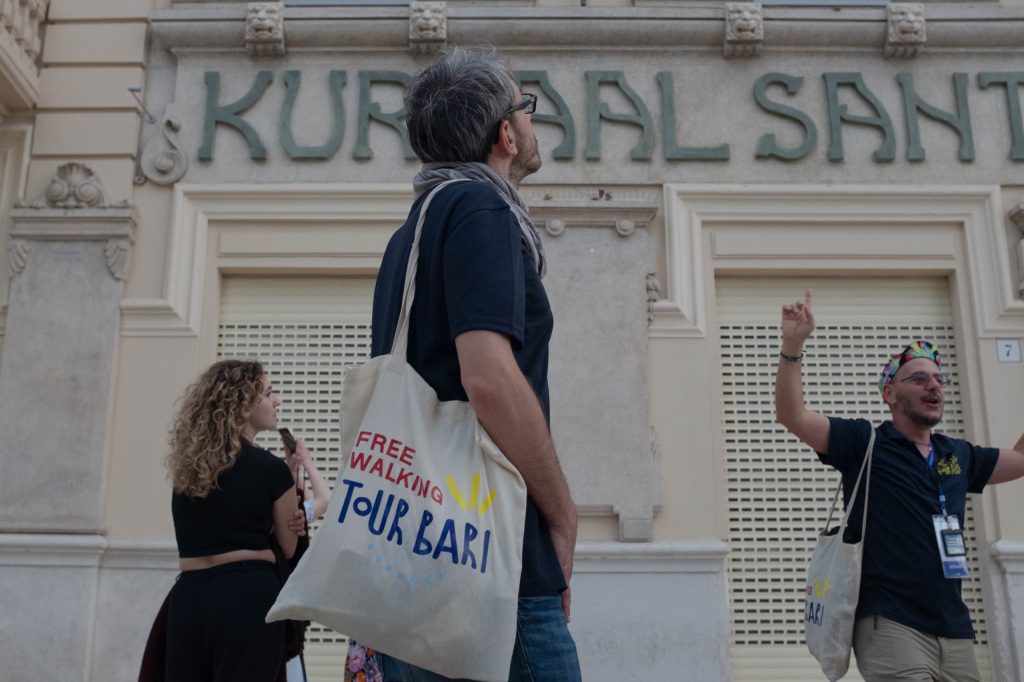
The Kursaal Santa Lucia theatre
Our itinerary of the Madonnella neighborhood starts from a theater that retains its charm bohemian of the nearby Umbertino district: the Kursaal Santa Lucia Theatre.
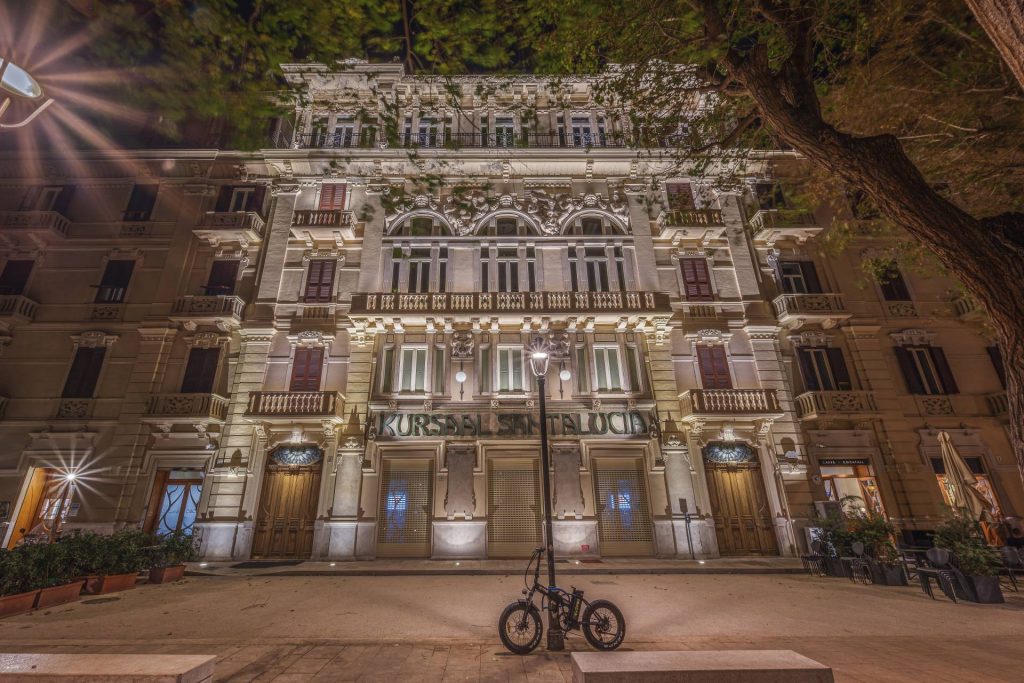
With its stylish facade in Italian liberty, this small theater is rightfully among the most beautiful (and most photographed!) buildings in Bari.
Commissioned in 1925 by the prestigious Santalucia family, this politeama theater was created with the aim of competing with other historic theaters in Bari.
Inspired Northern Europe kursaals, social venues with ballrooms, the Kursaal Theater achieved immediate success by offering prose, ballet and operetta shows.
With the advent of fascism and during the Second World War, however, the slow decline of the Kursaal Theater began.
In 1936 it was transformed into a recreational center for the lower middle class, changing its name to “Afterwork of the Civil Forces”.
Even after the end of fascism and the Second World War the Theater did not return to its original function. Inside it hosted a modest cinema, where poor quality films were shown.
It was in 1981 that the Theater seemed to return to its former glory. Thanks to impressive restoration works, The Kursaal reopened its doors with a new artistic direction entrusted to the famous Italian actor Gigi Proietti.
The success of the Theater lasted until 2011, when a new one began long period of abandonment which only ended in 2019 with the start of new restoration works.
In the 2021 the Kursaal Santa Lucia Theater is finally returned to the people of Bari as a public politeama theater… and as a museum!
The Church of the Blessed Virgin Immaculate
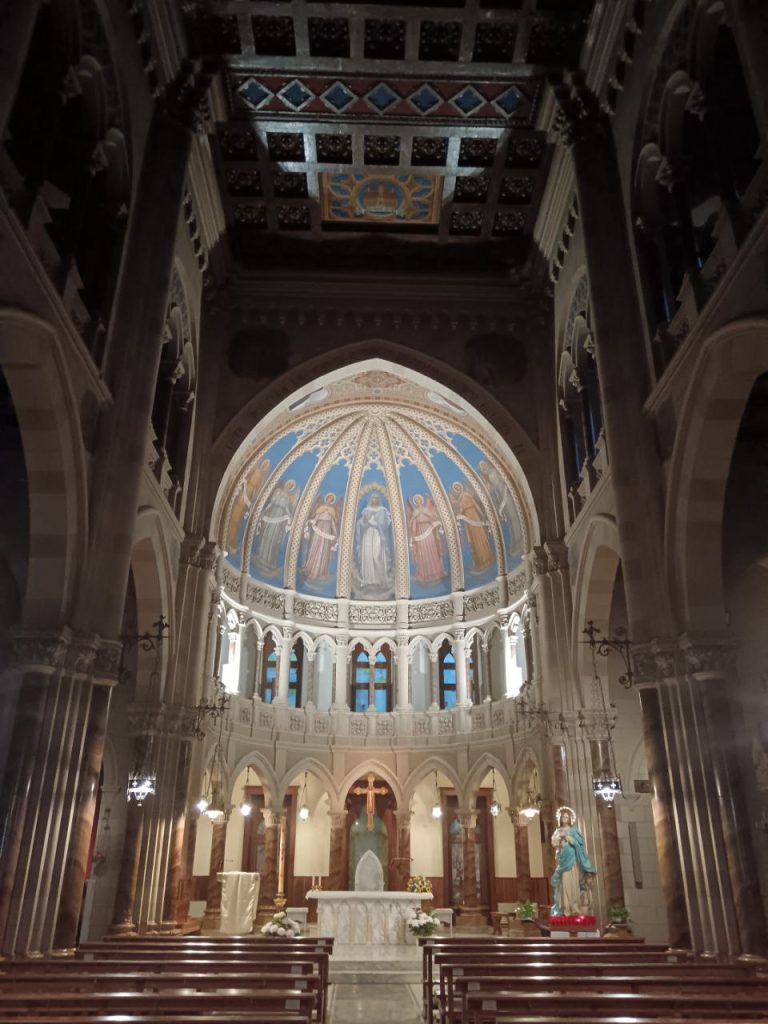
A few meters from the Kursaal theater and right on the border between Madonnella and the Umbertino district stands a modest sand-colored church which hides surprising frescoes inside.
It’s the Church of the Blessed Virgin Immaculate, inaugurated in 1926 in the same building that for a long time housed – strange, but absolutely true – a brothel.
The building was taken over by the congregation of the Capuchin Friars, who took care of the restoration and conversion of the building into a place of worship.
These redevelopment works were also possible thanks to the collaboration of the two artists Mario Prayer and Umberto Colonna, who decorated the interiors and the apse with splendid frescoes and paintings inspired by the Christian religion.
Prinz Zaum, the bookshop inside a dairy shop
When you walk through Madonnella, you can’t help but visit one of the most famous and popular cultural centers of our city: Prince Zaum.
Prinz Zaum was born as small independent bookstore and in recent years it has evolved into a literary cafe which hosts concerts, readings, presentations and cultural debates.
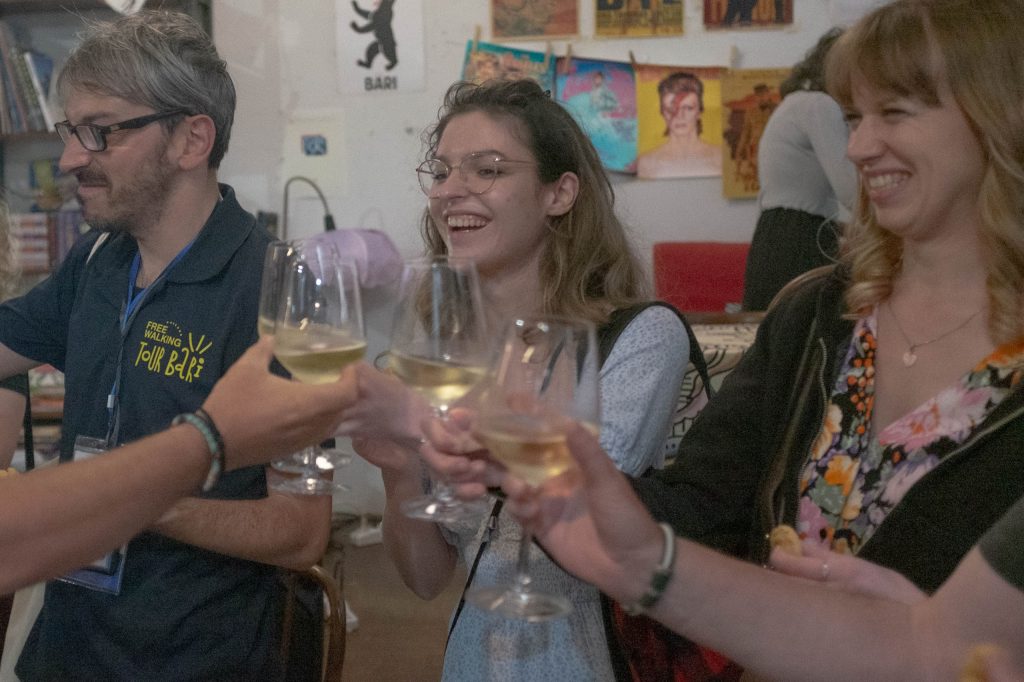
What makes Prinz Zaum so special, however, is the building in which its headquarters are located.
The shelves and counter of this bookshop have brought a precious place for the popular culture of Bari: the historic Latteria Principe.
For over 80 years, Latteria Principe has provided milk, cheese, cream and even ice cream to all the inhabitants of the Madonnella and Umbertino neighborhoods.
His fame was such that even today, especially in the most popular districts, a person with very full breasts is usually given the nickname “Latteria Principe” by friends and relatives!
The last stops of the free tour: Piazza Diaz and Largo Giannella
The journey of our free tour The Bohémien can only end in front of the Bari seafront, a few steps away from which there is a small playground full of lights and children.
Between trains, slides, swings and the inevitable carousel, Piazza Diaz it is a small island dedicated to childhood and carefreeness just a few steps from the public housing of Madonnella.
These are the only permanent electric rides in Bari, which for more than 30 years have enlivened summer afternoons and evenings for all the children in the neighborhood.
Right in front of the children’s games, a large circular square opens up overlooking the Bari seafront.
It’s about Largo Giannella, the last stop of our free tour The Bohémien. And it is right here, between the sea and the buildings of Madonella, that we feel the eclectic and colorful soul of our beautiful city most strongly.

Do you want to experience this journey through the most elegant and fascinating neighborhoods of Bari first hand?
Book your free tour from our website in 3 clicks The Bohémien and let yourself be guided by storytelling creative and captivating from our amazing team!